Anyox: the copper town that burned and was forgotten
 Marek Halden
Updated 24 September 2026
8 min read
Observatory Inlet, British Columbia, Canada
Marek Halden
Updated 24 September 2026
8 min read
Observatory Inlet, British Columbia, Canada

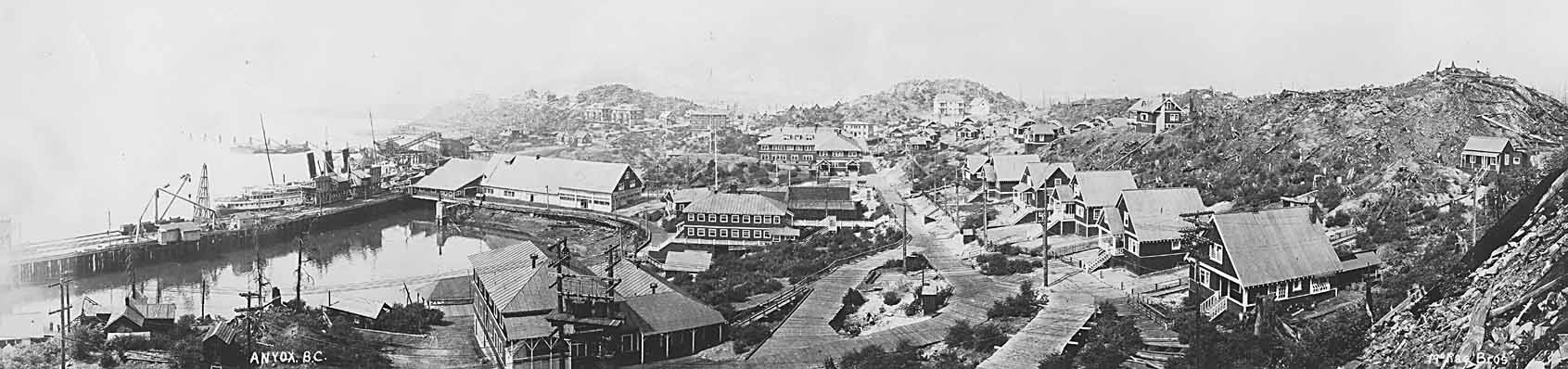
Anyox was never meant to be temporary. It was a full company town on the shore of a British Columbia fjord — with a smelter, a hospital, a curling rink, a golf course and its own railway — built to last as long as the copper did. It lasted twenty-five years. When the mine closed in 1935 the town was abandoned, and two forest fires finished the job.
A town at the end of a fjord
The Nisga’a knew the valley as a hunting and trapping ground, and the name Anyox means ‘hidden waters’ in their language. In 1910 the Granby Consolidated Mining, Smelting and Power Company began buying land on Granby Bay, on Observatory Inlet, and found copper in the mountains behind it. Construction of the town began in 1912.
By 1914, Anyox held almost 3,000 people and a smelter in full operation, fed by the Hidden Creek and Bonanza deposits. There was no road or rail link to the rest of British Columbia; everything came and went by steamship, to Prince Rupert and Vancouver. The company built a hydroelectric dam — for years the tallest in Canada — to power it all, and the town had amenities that many cities lacked, including, in 1918, the first wooden tennis court in the country.
The end of copper
Anyox was a company town in the fullest sense: the company owned the houses, the store, the hospital and the recreation. When the copper market failed in the Great Depression, the company stockpiled three years of production it could not sell, and in 1935 the mine shut down. The town was abandoned almost at once.
What the departing owners did not take, nature did. Salvage crews in the 1940s stripped out most of the machinery and steel, and forest fires in 1942 and 1943 burned the remaining wooden buildings. In twenty-five years of operation, Anyox’s mines and smelters had produced some 340,000 tonnes of copper, along with gold and silver — a fortune that left, and never came back.
Hidden waters
Today Anyox is a ruin on the edge of the wilderness, reachable only by boat or floatplane. Concrete foundations, the old dam and a scatter of brick and steel are all that mark where the streets were. The smelter’s acid rain had already stripped the nearby hillsides bare, and the forest has been slow to return.
Anyox is a hard place to reach and a strange one to stand in: a town that was built to be permanent and is now almost entirely gone. It belongs in this archive beside Ocean Falls and Uranium City, as one more reminder of how quickly a place built around a single resource can be erased when that resource stops paying.


About Anyox
Anyox is a remote, largely destroyed ghost town with no road access. It is not a managed visitor site.
- Access is by boat or floatplane only.
- The ruins are unstable and the site is isolated; go with an experienced guide.
- There are no services, no shelter and no mobile phone coverage.
Frequently asked questions
Where is Anyox?
On Granby Bay, Observatory Inlet, on the coast of British Columbia, about 60 kilometres south of Stewart with no land link.
What happened to Anyox?
The Granby copper mine and smelter closed in 1935. The town was abandoned, salvaged in the 1940s and burned by forest fires in 1942 and 1943.
How big was Anyox?
It held almost 3,000 people by 1914 and produced around 340,000 tonnes of copper over its lifetime.
Can you visit Anyox?
Only by boat or floatplane. It is a remote and unstable ruin with no facilities.
Related places
If this one stayed with you, these entries sit in the same corner of the archive:
- Ocean Falls: the rain-soaked mill town that almost vanished — Canada
- Uranium City: the boomtown that lost its reason to exist — Canada
- Ougrée: the steelworks that built a country — Belgium
Marek Halden
Marek Halden has been photographing and researching abandoned places since 2019, working legally and leaving every site as found. This archive records architecture, history and the human stories behind the walls — and never encourages trespassing.